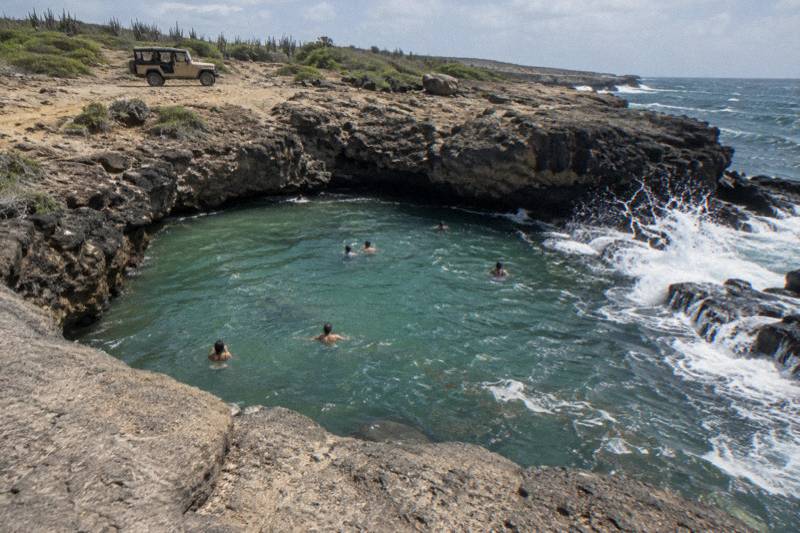
Can You Swim In Conchi Natural Pool?
Yes, swimming is possible at Conchi Natural Pool in Aruba, but only when the ocean is calm. Here is how swimming actually works there, who decides, and which tours fit.
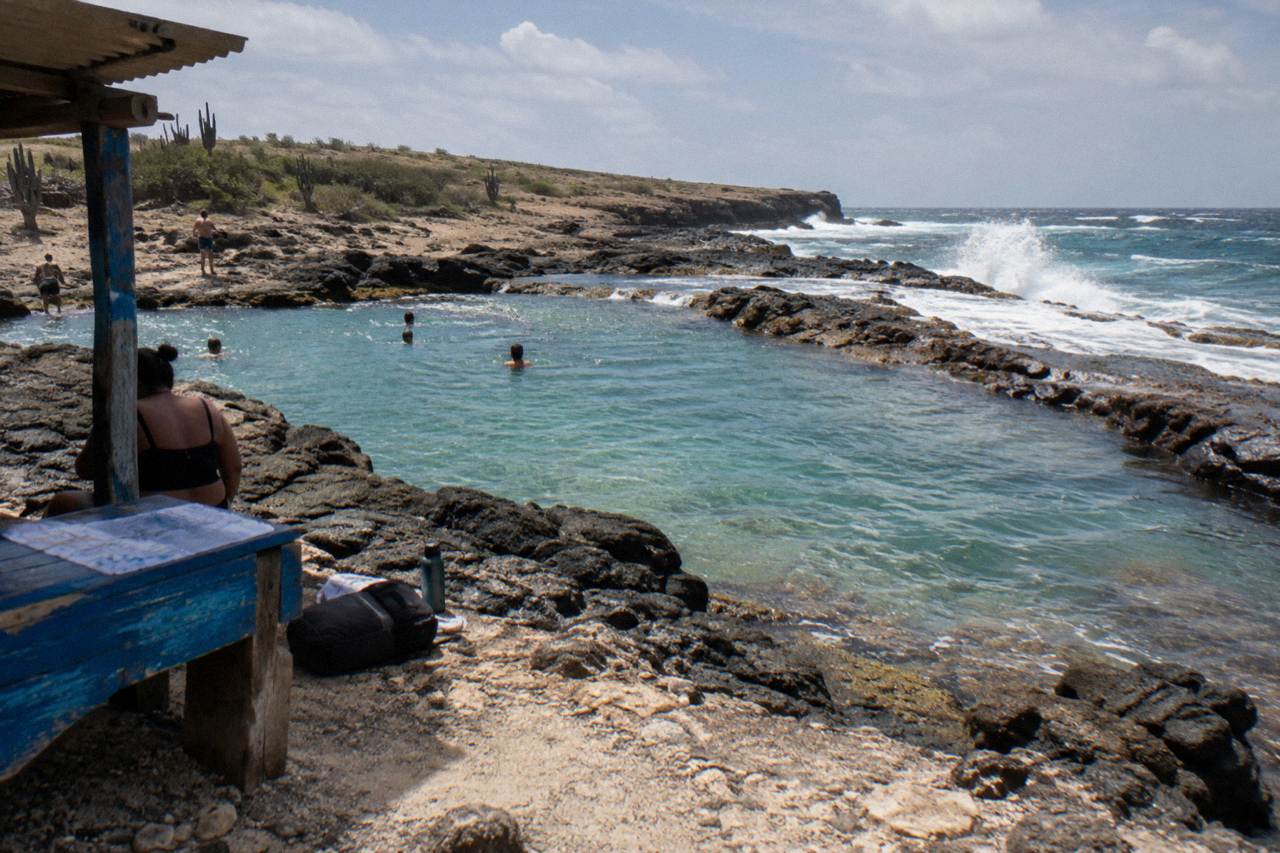
Conchi, also called Cura di Tortuga, is a small volcanic basin on Aruba's north-east coast where rock walls block most of the surf and leave a pocket of quieter water. The island's official tourism pages describe it as a place to swim and snorkel in a calm basin, and that is exactly what draws people. The honest answer is conditional: people do swim there, on the right days, but the ocean decides, and it can change its mind within hours. This page walks through what swimming there is actually like, what rangers and tour operators look at before letting anyone in, and which of the tours covered here include a swim stop at the pool. It also covers the rock, the footwear question, and what to do if you arrive on a day when the answer is no.
Yes, swimming happens at Conchi, and the island's official pages describe swimming and snorkeling in the calm basin, but only when ocean conditions allow. Waves can crash over the volcanic rim, conditions change quickly, and rangers and tour operators make the call on the day. No listing can promise you a swim, and neither can this page.
The Natural Pool sits inside Arikok National Park, a 34 square kilometer protected area on the windward side of the island. The pool is exactly what the name suggests: a depression in dark volcanic rock, partly enclosed, with the open Atlantic beyond. On a calm morning the water inside is clear enough for snorkeling, and small fish work the edges of the basin. On a rough day, waves burst over the outer rocks and the pool becomes a churning bowl that nobody should be in.
That daily variability is the single most useful thing to understand before you plan around a swim. The official Aruba page for the Natural Pool is direct about it: swimming is only safe when ocean conditions are calm, waves can crash over the rocks, and visitors should follow ranger advisories and posted warnings. Water shoes are strongly recommended on the sharp, slippery rock. There is no lifeguard tower with set hours described anywhere official; the park states that a ranger or posted signage is the authority on the spot.
What this means practically is that you should book the trip you want and treat the swim as the likely outcome, not the guaranteed one. Tour operators who run into Arikok every day read the conditions constantly, and their guides make the decision at the pool, not at the hotel pickup. If swimming is the whole point of your day, pick a listing that actually stops at Conchi, give yourself the best window of the day for calm water, and have a plan B that is still a good day out. For the full picture on access, why Conchi sometimes closes to swimmers explains who makes that call and what to ask an operator before you pay.
The Arikok National Park Jeep Safari (from $95 per person, 4.9 from 505 reviews) includes the National Park entrance fee and spends 20 minutes at Conchi in an open-air safari truck. The Signature Jeep Tour (from $78 per person, 4.9 from 1,718 reviews) drives into Arikok for 30 minutes at the pool, with ice water included and the park entrance listed as excluded. The Sunrise Hike and Swim (from $59 per person, 4.9 from 123 reviews) walks the north coast to Conchi at first light, which is when the basin is most often at its calmest and quietest.
When Is Swimming Safe At The Pool?
Safety at Conchi is decided day by day, and often hour by hour, by rangers and by the tour guides standing at the rim. The ocean on this coast is live Atlantic swell, and the pool's volcanic walls filter it, they do not stop it. When waves wash over the rim, swimming closes; when the basin settles, it opens. Nobody can tell you in advance which day you will get.
The mechanism is simple. Conchi is a shallow depression in the shoreline rock with openings to the sea. In calm conditions the rock absorbs the swell and the inside stays gentle enough for a relaxed float or a slow snorkel along the inner walls. When the swell rises, each set pushes sheets of water over the rim, and that surge has to drain back out through the same openings, which creates currents inside the pool that are strong enough to move an adult around. This is why the official guidance never frames safety as a season or a month. It frames it as a condition and a decision.
Rangers base the call on what they can see: wave height on the outer rocks, how far spray is landing, and how the basin drains between sets. Tour guides do the same when they bring groups in. A guide who says not today is not being cautious to avoid liability, that person is standing on the rock reading water you cannot see from the parking area. Follow posted warnings and follow the guide; both are named as the authority in the park's own materials, and the Aruba Conservation Foundation's park page is the source for current park rules and hours.
A note on what official sources do not say: no page in the park's or the tourism authority's materials promises a swim, gives a swell calendar, or names months when the pool is calmest. If you read a claim like that anywhere, treat it as one writer's guess. What is verifiable is the description of the pool as a calm basin in the right conditions, and the standing advice that conditions change quickly.
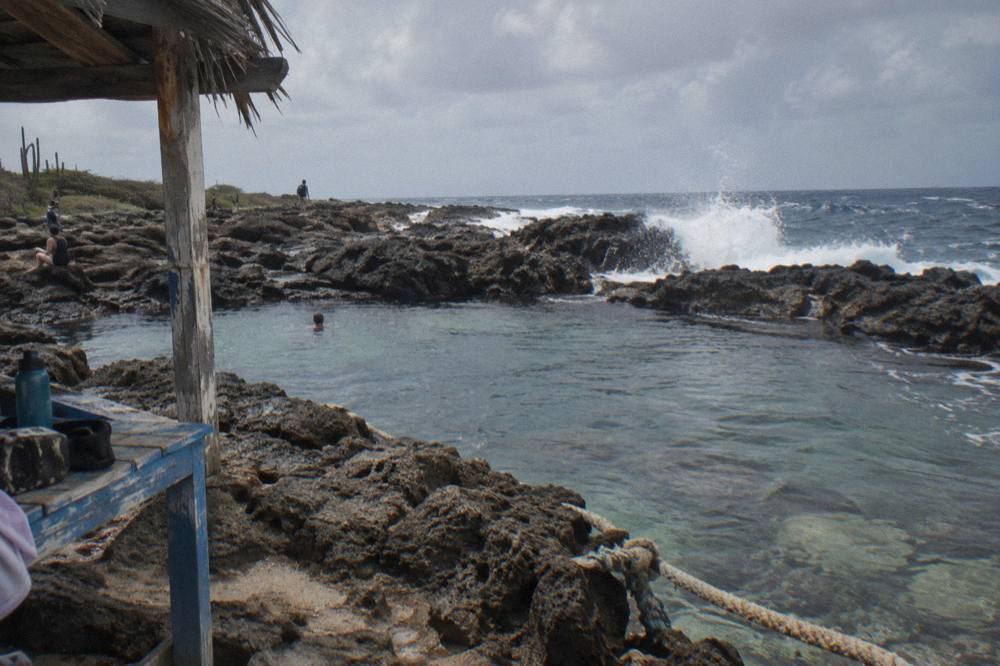
The rough-water scenario is worth visualizing before you go, because it changes what you pack and how you schedule. On a closed day you can still stand at the rim, watch the spray, and photograph the coast; the pool remains a genuinely dramatic place to look at. Several listings in this group pair the Conchi stop with caves, Baby Beach or other stops, so a no-swim call costs you one element of the day, not the day itself.
What Is Swimming At Conchi Actually Like?
On a calm day, Conchi is a short, shallow, saltwater soak more than a lap-swim. The basin is small, the floor is volcanic rock rather than sand, and the pleasure of it is the setting: clear green water, dark stone, spray on the horizon. Snorkeling in the calm basin is described on the island's official pages, and most jeep tours that stop here bring masks.
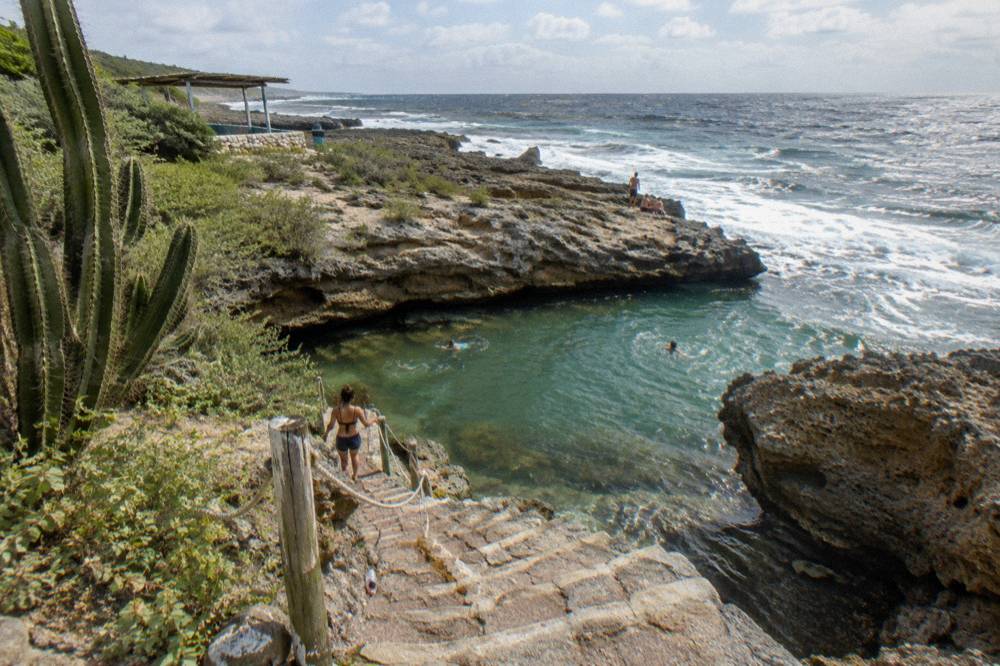
Getting down to the water involves uneven terrain and steep natural stone steps, and the park's own page notes the pool is not wheelchair accessible and needs moderate physical ability. Once at the water, footwear matters. The rock underfoot and around the rim is sharp and, where wet, slick; the official guidance strongly recommends water shoes, and this is one recommendation to take at face value. Reef-safe sunscreen, a towel and more drinking water than you think you need round out the kit. Facilities are limited; the official page notes only that a small snack and refreshment stand is often available at the top of the stairs during the day, so plan as if it might not be.
The water itself is salt and renewed by the sea through the openings in the rock, which is why it stays clear on calm days. Fish come and go through the same gaps, which is what makes the snorkeling work: it is not a reef dive, it is a slow circuit of a rock bowl with fish traffic. Listings on this site describe the pool stop with times that range from about 20 to 45 minutes at Conchi depending on the tour, which is enough for a swim, a snorkel and photos, and not enough for a full beach afternoon. That is the honest shape of the experience.
For readers comparing swim options, here is how the main tour types listed here handle the Conchi stop. Every row uses the listing's own figures for duration and time at the pool; the full listing has the current details for each.
| Tour type | Example listing | Time at Conchi | Swim suitability |
|---|---|---|---|
| Open-air safari truck | Arikok National Park Jeep Safari, from $95 per person, 4.9 from 505 reviews | 20 min | Short swim and snorkel window |
| Shared 4WD jeep | Signature Jeep Tour, from $78 per person, 4.9 from 1,718 reviews | 30 min | Swim plus photos, cave and Baby Beach stops |
| Sunrise hike | Sunrise Hike and Swim, from $59 per person, 4.9 from 123 reviews | At the pool mid-walk | Calmest, quietest window of the day |
| Horseback ride | Rancho Loco Horseback Ride, from $155 per person, 4.9 from 1,270 reviews | Ride stops at the pool | Swim listed as an inclusion of the ride |
One caution that applies to every row: a stop at the pool is not a swim, and a swim is not a sure thing on any of them. The operator decides at the rock. The listings above name the swim where it is included, and the sea still gets the final word.
Which Tours Include A Swim Stop At Conchi?
Only listings whose own description says they stop at the Natural Pool include a swim opportunity, and on this site that means the jeep safaris that drive into Arikok, the guided hikes, the horseback rides from Rancho Loco, and one UTV package that transfers into the park by jeep. North-coast ATV and UTV rides do not reach Conchi at all, because those vehicles are banned inside the park.
The featured trip for this question is the Arikok National Park Jeep Safari, a 5-hour shared tour from $95 per person, rated 4.9 from 505 reviews. It departs from Aruba hotels and the cruise terminal, includes the National Park entrance fee in its listed price, and drives into Arikok in an open-air safari truck with 20 minutes at Conchi. Free cancellation is listed, and bottled water and snacks are included. You can check the Arikok Jeep Safari's live listing for current times and availability.
Budget-wise, the Signature Jeep Tour is the cheapest listing here that drives into the park, from $78 per person with a 30-minute Conchi stop, though its exclusions list the Arikok entrance fee separately, so budget for the park pass in addition to the fare. At the other end of the scale, the 6-hour UTV Adventure with jeep transfer, from $399.68 per person and 5.0 from 7,302 reviews, includes lunch and reaches Conchi by a guide-driven jeep for the final section into Arikok, since the UTV itself never enters the park.
For travelers who would rather earn the swim, the half-day Arikok hike with snorkel, from $115 per person and rated 5.0 from 39 reviews, hikes the park and then snorkels at Conchi, with entrance fee, private transportation, water and fruit included. And for a different arrival entirely, the Rancho Loco horseback ride from $155 per person lists a swim in the famous Natural Pool among its inclusions, with a strictly enforced maximum rider weight of 220 lbs fully clothed as its listing states.
Do You Need A Tour To Swim At Conchi?
No, but you cannot drive a regular car there. The park states the pool is reached by foot, horseback or 4x4, standard passenger cars are not permitted beyond the checkpoints toward Conchi, and experienced hikers can do a 3 to 4 hour round trip. A valid Arikok day pass is required by law, sold only at the entrances, not online.
The pass costs USD 22 per adult, children under 17 enter free, and the Aruba Conservation Foundation sells day passes at the San Fuego Visitor Center and the Vader Piet booth; check the park's own page for the current price before you go. San Fuego's pass sales close at 3:30 in the afternoon, and Vader Piet closes at 3 pm. There is no timed-entry system for self-guided visits; you buy the pass at the gate. Guided experiences with the park's own rangers, including hikes on trails like Cunucu Arikok and Miralamar at USD 25 per person per the park's site, are booked in advance by email.
The self-guided 4x4 route is real but demanding. The track to Conchi is rough, rocky and unsigned in stretches, and the park's rules hold inside the boundary: stay on park roads, 20 km/h speed limit, no drones, no pets, no littering. Drivers without local knowledge are pointed toward the guided jeep safaris, which is the route most visitors take for good reason. Hikers should treat the official 3 to 4 hour round trip for experienced hikers as the honest benchmark and carry water accordingly.
The listing above sits in the middle of that self-guided versus guided question: it is a guided hike that covers the park on foot and ends with the Conchi snorkel, which gets you the trail experience without route-finding risk. More on the trade-offs is in the site's hiking to the natural pool guide, and the wider Conchi Natural Pool guide covers every access option in one place. For the planning side of fees, the Arikok tickets and fees guide breaks down the pass in full.
What If The Pool Is Closed For Swimming On Your Day?
A no-swim call costs you the dip, not the trip. The pool's rim, the north-east coast and the rest of Arikok remain open, the tours reroute their time into caves, Baby Beach and coastal stops, and the park itself has caves, rock drawings and bays worth the entry fee on their own. Ask the operator how they handle a closed-pool day before booking.
This is a fair question to send any operator in advance: what happens to the itinerary if the ranger closes the basin? Operators who run into Arikok daily have a standard answer, usually more time at caves such as Quadirikiri or Fontein, a longer Baby Beach stop, or a coastal viewpoint extension. None of that is a substitute for the swim, but it is a full day in a park that covers nearly a fifth of the island, and the tourism authority lists the caves, the rock drawings and ranger-guided walks to bays like Dos Playa among the park's own highlights.
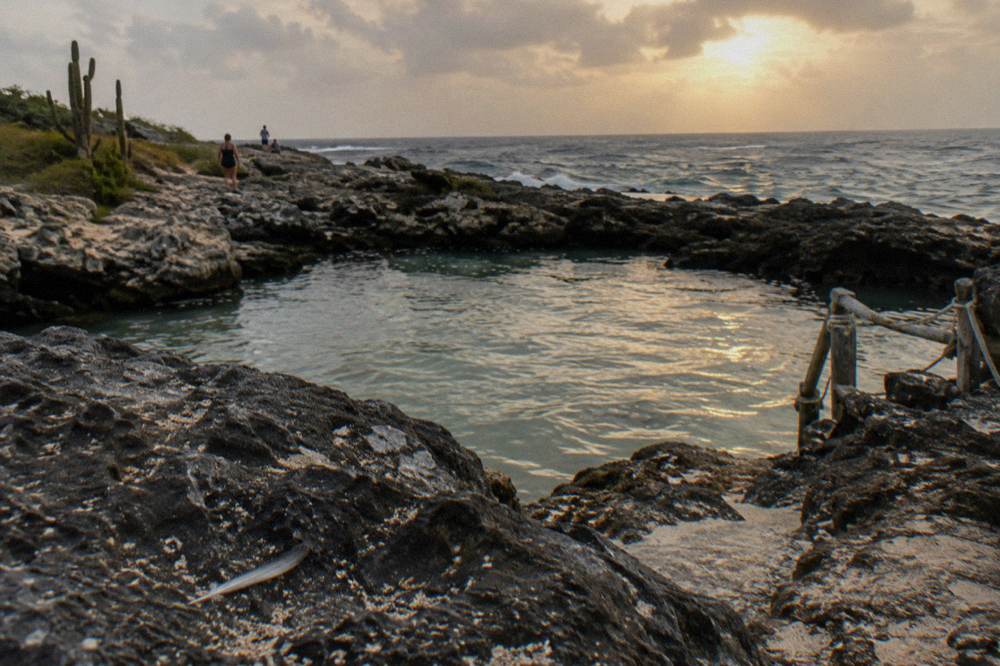
Timing still tilts the odds without promising anything. Sunrise-departure listings exist precisely because early morning tends to be the calmest and coolest window on this coast, and the Sunrise Hike and Swim listing at from $59 per person is built around that logic. But the honest framing, which the site behind this article, Aruba Natural Pool Tours, holds to everywhere, is that the sea decides. Choose a listing with a Conchi stop, go early, wear the water shoes, and let the rock and the ranger tell you on the day whether the basin is yours.
Common Questions About Swimming In Conchi Natural Pool
Can You Swim In Conchi Natural Pool?
Yes, on days when the ocean is calm. The island's official pages describe swimming and snorkeling in the calm basin, and note that waves can wash over the volcanic rim and conditions change quickly. Rangers and tour operators decide on the day.
Is Swimming At Conchi Safe For Children?
The park's own page says the pool needs moderate physical ability and is not wheelchair accessible, with uneven terrain and steep natural stone steps. For age limits, kid pricing or medical policy on any packaged tour, check the listing or ask the operator directly.
Do You Need Water Shoes At The Natural Pool?
Yes, they are strongly recommended on the park's official page. The rock around and inside the pool is sharp volcanic stone, slick where wet, and regular sandals handle it badly.
Can You Snorkel At Conchi?
The island's official page describes snorkeling in the calm basin, and several listings here include snorkel equipment, among them the Arikok Jeep Safari and the Signature Jeep Tour. Snorkeling depends on the same calm conditions as swimming.
Is There A Fee To Swim At The Natural Pool?
There is no separate Natural Pool fee listed on the official pages. What is required is the Arikok conservation day pass, USD 22 per adult with children under 17 free, sold at the park entrances; check the park's own page for the current price.
Can A UTV Or ATV Tour Take You Swimming At Conchi?
No. UTVs and ATVs are banned inside Arikok National Park, so those rides run north-coast routes outside the park. The way in to Conchi is a jeep or 4x4 tour, a horseback ride, or a hike.